


You are here
Workshop Programme
Workshop Programme
Our conference is supplemented by a programme of workshops led by members of our community. These events must be booked separately from the conference.
Tickets are limited and available on a first-come, first-served basis. Participants can select one full-day workshop or two half-day workshops but be mindful of scheduling conflicts, when selecting your choice.
Please note: Attendance is in-person only and you do not have to attend the conference to register for the workshops.
IDCC26 Workshop Programme, Monday 16 February
All times are in Central European Time (CET).
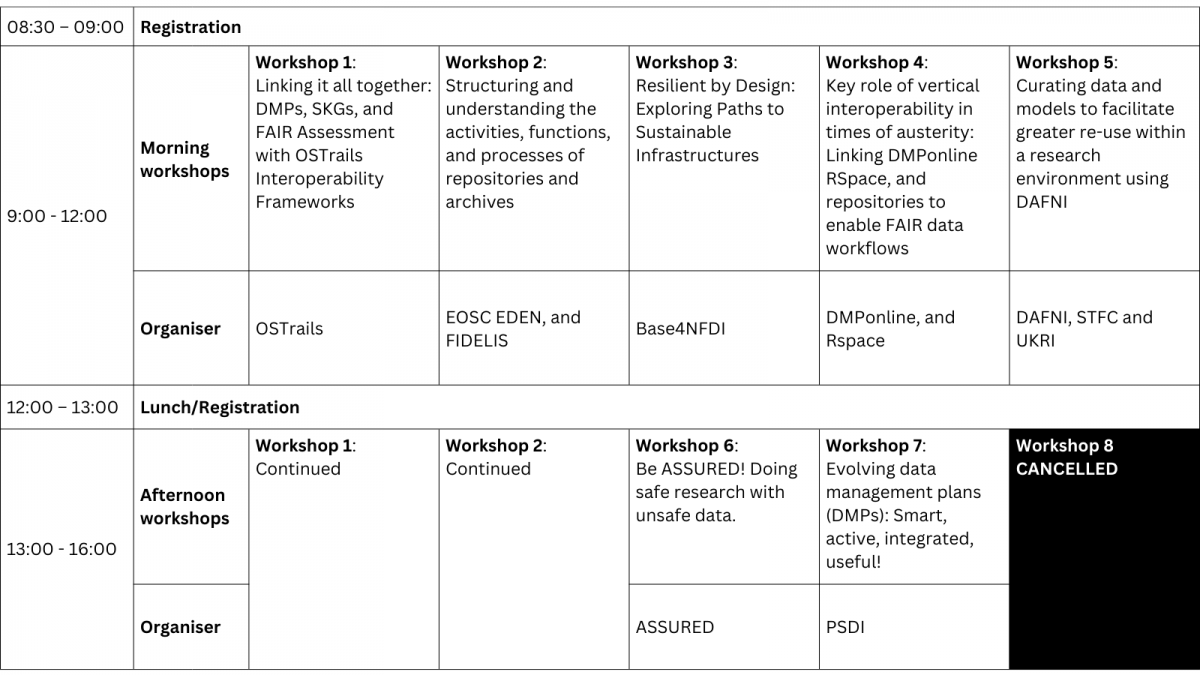
Please note: Registration opens 30 minutes before each Workshop.
IDCC26 Workshop Summaries
Workshop 1 - Linking it all together: DMPs, SKGs, and FAIR Assessment with OSTrails Interoperability Frameworks - OSTrails
This full-day workshop invites members of the research data community to engage with the OSTrails project and its vision for building robust, reusable Interoperability Frameworks and a shared Commons to support research data management across the European Open Science Cloud (EOSC).
Participants will gain first-hand insights into three key Interoperability Frameworks developed within OSTrails:
- DMP Interoperability Framework – enabling machine-actionable Data Management Plans through standardized APIs and metadata.
- SKG Interoperability Framework – leveraging Semantic Knowledge Graphs to connect and contextualize research outputs.
- FAIR Assessment Framework – providing tools and metrics to evaluate and improve the FAIRness of research data and services..
Workshop 2 - Structuring and understanding the activities, functions, and processes of repositories and archives - EOSC EDEN and FIDELIS
Trustworthy digital archives and repositories are essential parts of the research landscape. They execute a myriad of activities, functions, and processes that support the care and long-term preservation of digital objects. However, structured definitions of these different characteristics are currently lacking. Sister projects EOSC EDEN and FIDELIS have created both an overview of Core Preservation Processes (CPP) and transparent displays of trustworthy activities and functions (TTRAM) to start to define these important elements as a structured basis towards increased understanding, valuation, communication, and support. In this workshop, which also serves as the second ESOC EDEN Bootcamp, participants will be introduced to both outputs of the projects and learn how they relate to each other and can be understood and implemented. Interactive work with the models will allow participants to apply the work to their own archive or repository, contributing to the structured and transparent exposure of service provider information.
Workshop 3 - Resilient by Design: Exploring Paths to Sustainable Infrastructures - Base4NFDI
Digital curation hinges on open source and other services for digital infrastructure. Yet providing a sustainable and reliable basis in turbulent times remains a challenge. This interactive workshop invites experienced representatives from infrastructure and service providers—regardless of their current funding or governance status—to join a hands-on forum for identifying and addressing shared barriers to sustainability.
In targeted breakout sessions, participants will collaborate on real-world challenges spanning business models, governance, staffing, user engagement and more.
Drawing on previous panel discussions and project outputs, e.g. from the context of Germany’s NFDI, the session aims to produce actionable solutions and new approaches for building long-lasting services. Whether your infrastructure is newly launched or established with secure funding, whether you are facing acute challenges or seek fresh inspiration for mature service: this is the place to shape your infrastructure’s path and contribute to the resilience of research data infrastructure.
Results and ideas will be documented and provided to a wider audience - creating the basis for a catalogue of approaches for service sustainability.
Workshop 4 - Key role of vertical interoperability in times of austerity: Linking DMPonline RSpace, and repositories to enable FAIR data workflows - DMPonline and RSpace
Vertical interoperability, or the smooth, streamlined, and accurate transmission of data and metadata between different tools connected in a workflow, is crucial in times of austerity, when funding and resources are limited, and the workload and demands on data stewards and other data support staff are high. The workshop will demonstrate a practical implementation of vertical interoperability via the integration of DMPonline and RSpace in the context of FAIR research data management. It will involve community stakeholders in sharing their use cases, and explore the outstanding challenges, opportunities, and future directions in bringing vertical interoperability concepts to life across the research lifecycle and across domains via moderated, small-group discussions.
Workshop 5 - Curating data and models to facilitate greater re-use within a research environment using DAFNI - STFC and UKRI
This workshop will explore how to best curate data in order to optimise re-use of both data and computational models for research purposes. It will focus on discussing the metadata behind the resource and look at both what and why certain elements are required and necessary to allow for greater re-use. The workshop will demonstrate this using the DAFNI platform, hosted by STFC within UK Research & Innovation, as a dissemination platform for this metadata. The workshop will show attendees how to use DAFNI for data and model curation and dissemination. Examples shown in the workshop come from experiences of curating data and models in the UK Climate Adaptation community and expanding this to partners across Europe as part of the CROSS EU project. DAFNI is a free to use web platform that support academic research and hosts data and models allows for both to utilised in collaborative workflows developed in the platform with supporting visualisation. There are no knowledge or background requirements for attendees to the workshop and access to DAFNI will be given to attendees to allow them to work through the examples or allow them to test their own data.
Workshop 6 - Be ASSURED! Doing safe research with unsafe data - ASSURED
When working with data in research, there is the risk that the outputs of the research could lead to harm. This could be because a publication reveals personal information about a Data Subject or (mis)attributes something sensitive to a group of people. Although usually accidental, once in the public domain, such publications could be used maliciously, perhaps even by authoritarian groups seeking to justify their actions. For example, study results could attribute criminal tendencies to an already stigmatised group such as children of single parents or immigrant groups from certain populations.
The ASSURED project is developing a training and accreditation scheme aimed at researchers and professionals who handle sensitive research data with a particular focus on techniques such as Statistical Disclosure Control to reduce the likelihood that results could lead to harm. In this workshop, we will explore the issues that might emerge from results generated from sensitive research data, and the basic principles through which Safe Outputs can be produced. One key feature of ASSURED is a focus on interactive training, whereby participants are encouraged to debate and discuss the topics. This training is not only relevant for researchers, but also for professionals involved in making sensitive data available.
Workshop 7 - Evolving data management plans (DMPs): Smart, active, integrated, useful - PSDI
Initially intended to capture, at the onset of a research project, the planning process for how the research data will be collected, stored, accessed, shared, and preserved, data management plans (DMPs) have been growing in scope and importance. Despite their potential benefits, DMPs are subject to challenges. Often viewed as an annoyance and a document for compliance, once completed, they often languish forgotten and ignored.
DMPs capture important context for the research and how data will be captured, managed, and preserved. However, research is messy; our plans evolve, new technologies emerge, and we need to change and adapt our plans and processes to take account of these. Rather than static documents relevant just at the beginning of the project, DMPs should serve as an active, dynamically updated record of the research project: the how, what, and why of our research. They should apply to varied research outputs, not just narrowly defined research data; and link to the range of other tools that we use in our research.
DMPs have enormous potential for innovation to improve their utility. Consistent with the Data Management Plans for the next generation of research subtheme of IDCC26, this workshop will bring together a diverse group of practitioners from the scientific research ecosystem and tap into their unique perspectives and expertise to collaboratively imagine the possible future enhancements of DMPs for better research results, reuse, and reproducibility
CANCELLED - Workshop 8 - Data Speaks, Policy Listens: Communication Skills for Change - Marko Košiček and Petra Buljević Zdjelarević
This hands-on workshop offers participants the opportunity to familiarize themselves with the complex relationship between science, communication and policy. Through expert-led sessions, role-plays and collaborative activities, you'll explore how scientists can contribute to policy decisions, communicate research effectively and influence societal issues.
What participants will experience:
- Introduction to key concepts: discover the different roles that scientists play in policy - from pure scientist to advocate.
- Hands-on role-plays: Step into the roles of policy advisors and advocates as you participate in simulated panel discussions, pitches and presentations.
- Practical feedback: Receive feedback on your communication style, learn from real-life examples and get tips on how to effectively communicate messages to different audiences.
- Networking & collaboration: Connect with other participants who share an interest in bridging science and policy, learning from each other’s experience and expertise.
Workshop 8 is now cancelled