


You are here
Recognising Excellence in Open Science: Seteney Shami and Nada Chaya Share 2026 Sarah Jones Award
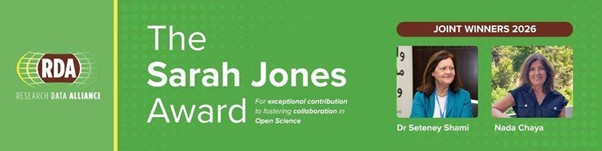
Dr Seteney Shami and Ms. Nada Chaya have been named joint winners of the 2026 Sarah Jones Award, recognising their outstanding contributions to fostering collaboration in Open Science.
Awarded every two years, the Sarah Jones Award celebrates individuals making a meaningful difference to collaborative Open Science practices. This includes work in education and training, research data management and FAIR data practices, with a particular focus on supporting open research in regions where establishing and sustaining these practices can be especially challenging.
Recognised by a panel of judges for their work at the Arab Council for the Social Sciences (ACSS), this year’s winners were honoured at the Research Data Alliance (RDA) 27th Plenary Meeting in London on the 6th of October. Alongside a physical award and certificate, they will be featured on the RDA Sarah Jones Award website and receive funding to support their ongoing work.
The award also carried a special significance. Sarah Jones was a much-loved former colleague and a valued member of the Digital Curation Centre community. It is wonderful to see her legacy live on through an award that champions the values she held so dear - Open Science, collaboration, community building and research data.
Laying the groundwork for open research
Dr. Shami, founding Director General of ACSS, and Ms. Chaya, Programme Lead for the Arab Social Science Monitor at the ACSS, built the Arab region’s first interdisciplinary, open-access social science research data archive, ACSS Dataverse.
The ACSS Dataverse gives researchers and institutions access to a growing collection of research data, while helping ensure datasets are preserved and managed responsibly for the long term. It now holds almost 200 datasets across eight sub-Dataverses, including anonymised survey microdata and shapefiles (files used to map geographic information). All datasets are freely available to registered users.
Rather than allowing researchers to deposit their own data directly, ACSS takes a more hands on approach by carefully reviewing and curating submissions. This helps ensure the quality and long-term sustainability of the archive, rather than focusing simply on the number of datasets it contains.
The initiative is also helping make Dataverse more accessible to Arabic-speaking researchers. By adapting language packs to support Arabic script, the team is contributing to wider efforts to make the platform work more effectively for Arabic and other right-to-left languages.
Better research through collaboration
The ACSS Dataverse was developed in partnership with the University of North Carolina at Chapel Hill, with support from the university’s Odum Institute and Research Data Management Core. Early funding from the Carnegie Corporation of New York, now the Andrew Carnegie Foundation, also helped launch and develop the initiative.
The work extends beyond infrastructure. ACSS has organised more than two dozen workshops on research data management, sharing and best practices, working with universities and research centres across the region. To date, these activities have reached more than 300 researchers and information specialists.
For Shami and Chaya, building strong partnerships and professional networks has been central to making Open Science practices sustainable.
Keeping Open Science alive in times of crisis
Much of this work has taken place amid prolonged economic, geopolitical and other crises across the region. To help safeguard continuity, Shami established ACSS branches in Jordan and the United States.
Their nominators describe this perseverance not as a single challenge that was overcome, but as an ongoing part of the environment in which the work has been carried out.
Jonathan Crabtree, Ph.D., Director, UNC, Research Data Management Core, said:
“Their perseverance through extraordinary economic and geopolitical hardships is amazing, and the research data community is lucky to have these advocates in our community.”
Charles Kurzman, Stadter Professor of Sociology at the University of North Carolina at Chapel Hill, said:
“I have benefited from their perseverance, their ability to forge professional relationships, and their remarkable good humour.”
More than an archive: Building a lasting legacy
The Sarah Jones Award Selection Committee, comprising Kevin Ashley, Former Digital Curation Centre Director; Ingrid Dillo, Deputy Director at DANS (Data Archiving and Networked Services); Rosie Hicks, CEO of the Australian Research Data Commons (ARDC); and Cathrin Stover, Chief Communications Officer at GÉANT, said:
“Seteney and Nada didn’t just build an archive, they built the conditions under which one could survive - trust, training, and a network of people willing to sustain it after they’d moved on. That’s exactly the kind of contribution this award exists to recognise.”
Congratulations to Seteney and Nada on this well-deserved recognition. Their work demonstrates the importance of collaboration, infrastructure and community in making Open Science more accessible and sustainable across different regions and research communities and we look forward to seeing the continued impact of their work.
Interested in open data initiatives? Explore the ACSS Dataverse today to access nearly 200 datasets or join the research community in promoting FAIR data practices worldwide.